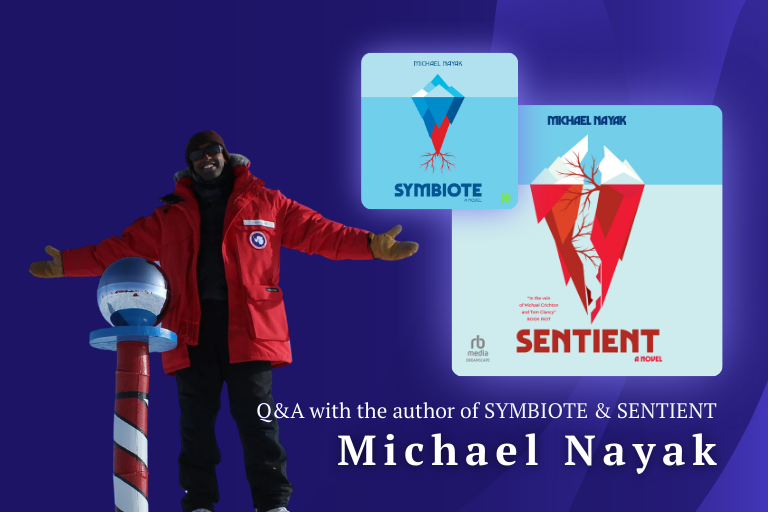
Michael Nayak isn’t your typical sci-fi horror writer. While most authors spin grim tales from the comfort of their favorite leather chair and with a warm bevvy in-hand, Nayak prefers a setting that’s a little more inspiring.
 |
 |
 |
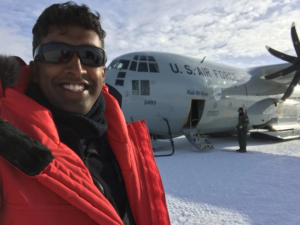
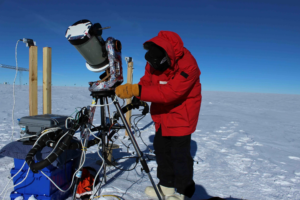
A former NASA planetary scientist, aerospace engineer, decorated military test pilot, and US Antarctic Program researcher, Nayak has spent his career operating in environments where a single miscalculation can be fatal. And when he sat down to write his debut novel, SYMBIOTE, he did it from one of the most hostile and remote places on Earth: the South Pole.
 |
 |
When you read his “Ice Plague Wars” series, whether with headphones or while clutching your Kindle, this firsthand experience will hit you like an icy blast and leave you thanking the heavens for your space heater. Because there’s nothing more terrifying than horrors that are very real and experienced every day in the name of scientific discovery…

Kicking off this Polar bio-horror saga, SYMBIOTE drops readers into an American research base at the (literal) bottom of the world. As if the unforgiving tundra wasn’t enough, an extremophile parasite—dormant until triggered by severe cold—begins spreading through the crew with terrifying, evolving speed and intelligence.
Fans of John Carpenter’s The Thing can already assume this doesn’t end well for anyone.
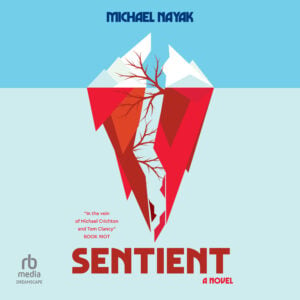
In SENTIENT, the survivors of this deadly outbreak discover that escaping Antarctica may be the most dangerous thing they’ve ever attempted. As they scramble to save themselves and the rest of the world from this growing threat, a new and even more lethal infestation takes hold and the CIA’s shadowy fingerprints are all over it.
Where can an already isolated team of researchers turn when the ones in charge are just as cold and uncaring as the tundra itself?
Both titles crackle with the hypothermic dread that can only come from someone who’s actually stared at the endless white expanse and felt its glare in return. Each page is infused with that bone-deep fear of knowing the ice doesn’t care if you make it home, in fact, it knows you probably won’t.
We sat down with Michael Nayak to talk about writing frigid sci-fi horror that seeps into your mind forever. Keep reading to learn more about why you’ll want to listen to his audiobooks with the lights on and a fire blazing!
- You wrote your debut title, SYMBIOTE, while stationed at the South Pole. How did being physically present in that frigid, isolated environment help you bring a realistic edge to the story’s setting?
The emptiness down at Pole does weird things to your brain. No contrails, no birds, no insects… just howling wind and bone-deep cold. Being there, and staring out at that icy expanse, it occurred to me that in a city, you can run away from danger. In Antarctica, you can’t. When you live in a place where stepping outside without the right gear can kill you in minutes, you develop a very practical understanding of vulnerability. The cold isn’t poetic. It’s mechanical, and it finds weak points.
I’ve always loved to write, and when writing at the South Pole, I didn’t have to imagine isolation. I was living it. So I tried to put what I was seeing and feeling down on paper. I leaned into the idea that the ice doesn’t care who’s right. It just waits. And that’s how the frigid environment became a character and played a part in the story I wanted to tell.
- Both of your titles within the “Ice Plague Wars” series present science itself as the scariest character. Given your expertise in planetary science, extremophile research, and aerospace technology, how do you decide where real science ends and fiction begins? And how do you think this added layer of reality amplifies the horrors within the story?
I don’t see a hard line between real science and fiction: I see a gradient.
My scientific background means I know what organisms are capable of under extreme conditions. I treat science like a loaded Chekhov’s gun, because nature is already far stranger than most fiction. So I tried to start everything fictional with what we genuinely understand about biology, virology, and Antarctic logistics. If it’s real, it stays real in the story. Extremophiles, viral mutation, aerospace tech: that’s all grounded in real scientific possibility.
The fiction creeps in at the margins: what if this happened faster? What if someone pushed it further? What if the urgency of winning a war made your ethical lines blur? The horror works because 90% of it could exist in a lab somewhere. The last 10% is what keeps you (and me) up at night. The horror works because readers know the scaffolding is real.
- Classic films like The Thing and 30 Days of Night, as well as the True Detective: Night Country season all use extreme environments to put the characters (and reader) in a place that’s more like a psychological trap than a simple setting. How do you use the Antarctic landscape to elicit similar feelings of dread and fear in a way no other setting can?
Extreme environments strip away illusions of control. In Antarctica, the landscape doesn’t care about your plans or your rank. If the weather turns, it turns. It’s indifferent to you. That indifference creates a psychological pressure cooker.
I use the Antarctic landscape almost like negative space. There’s nothing out there: no trees, no cities, no humans that walk in from off-frame… no escape. That emptiness forces the characters inward, toward their own fears and suspicions. I think movies and shows like The Thing and True Detective: Night Country get that right: the environment itself is complicit. It’s not just a backdrop; it’s a constraint. And constraint is where tension thrives on the pages!
- In both SYMBIOTE and SENTIENT, the threat isn’t just biological, it’s also found within the paranoia and power struggles (political and personal) of the stories’ characters. How does the more “human” tension add to the very real fear you may have experienced yourself while working in close quarters in the Antarctic?
Biological threats are frightening, but they’re impersonal. Human tension is intimate.
In Symbiote and Sentient, the real breakdown happens when crew members start questioning who’s on their side, who’s hiding what, and whether staying alive is worth losing yourself. When you live and work in close quarters in the polar regions, you realize how much survival depends on trust. You have to believe that the person maintaining the generator knows what they’re doing. You have to believe your team will make rational decisions under stress.
Once that trust fractures — whether because of politics, ego, or fear — the environment becomes even more dangerous. I’ve seen that both in Antarctica and my time in the military, more generally. The paranoia in Symbiote and Sentient isn’t layered on top of the threat; it amplifies it. A compromised team in Antarctica can be more dangerous than any virus.
- SENTIENT pulls back the curtain on Have Viking—a covert CIA program behind the original outbreak in SYMBIOTE. How do you navigate using your own experience working on classified government projects authentically without giving too much away? Is there anything about these projects that make them perfect horror story fodder?
A great question! You’ll notice that the very first page of the book says: “This publication has been cleared for unlimited public release by the Defense Office of Prepublication and Security Review.” That means someone else steeped in the classified world has positively determined that I’m not giving too much away!That being said: working on classified projects has given me insight into how those ecosystems function. I’ve lived the compartmentalization, the urgency, the ethical gray zones.
With something like Have Viking in Sentient, I’m careful to separate experience from specifics. What I draw from is the atmosphere: brilliant people solving difficult problems under pressure, often without full visibility into the bigger picture. That structure lends itself naturally to horror. When information is restricted and decisions are made in silos, unintended consequences become inevitable. So I’ve borrowed the emotional architecture — the sense of scale and secrecy — and then I’ve let fiction do the rest. - Feelings of isolation, dread, and a general lack of control over your environment are all deeply sensory-based emotions. How do you think listening to these stories on audiobook will amplify these feelings in a way that reading words on a page cannot? Do you feel the narrators, Graham Halstead and Paul Bellantoni, bring an extra aura of gravity and suspense to these already tension-filled stories?
I’m a firm believer that audiobooks change the sensory experience of a story! When I’m reading on the page, I control the pacing. I can skim. I can pause. Listening removes some of that control, which actually mirrors the themes of isolation and lack of agency in these books.Graham Halstead and Paul Bellantoni bring a grounded seriousness to the material. They don’t over-dramatize it, which I appreciate. They let the silence do the work. In stories like these, restraint is powerful. A quiet line delivered with weight can land harder than something theatrical. The tension becomes less about spectacle and more about inevitability, which to me, feels very true to the setting.
Looking for more audiobooks that’ll give you chills?
Check out our other blogs below for perfectly horrific listens you can take anywhere—even the South Pole!
Gothic Literature’s Evolution and Influence from Frankenstein’s Monster to Netflix’s Wednesday
Home Is Where the Horror Is: Must-Listen Audiobooks with Haunted Houses and Dark Family Secrets