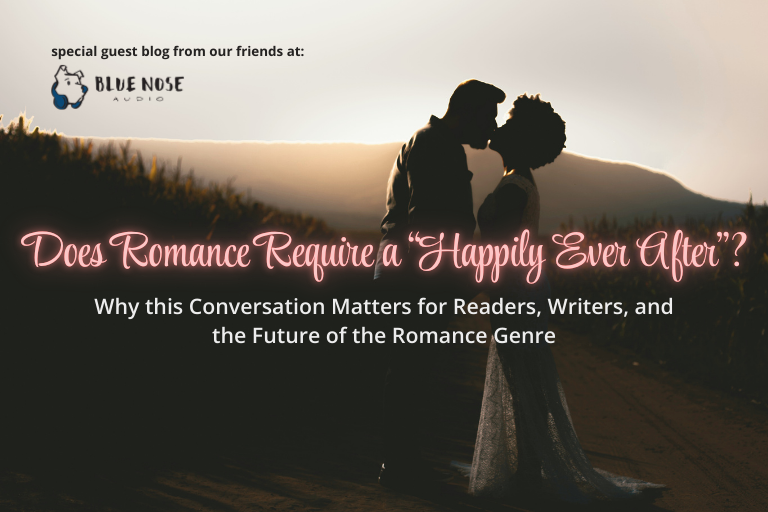
In the world of romance, few topics spark more passionate discussion than this:
Does a story have to end with a “happily ever after” (HEA) to truly qualify as a romance?
Some readers and writers believe the answer is an unequivocal yes and that without the promise of forever, a story simply doesn’t belong in the genre. Others argue that romance is not about the permanence of the ending, but the journey of love itself.
At Blue Nose, we believe this is a conversation worth having because the future of romance storytelling depends on how openly we engage with these questions.
The Promise of the HEA
There’s no denying that HEAs have long been central to the romance genre. For many readers, they are a source of comfort and a guarantee that love will triumph no matter what obstacles the characters face. That promise has built trust, reliability, and even identity for the genre.
And yet, if we’re honest, none of us really knows what comes after the words “happily ever after.” Permanence isn’t guaranteed in real life; even the most beautiful love stories can end unexpectedly.
“Happily Ever After (For Now)” aka “Happy For Now”
Consider a couple who have been married for over 30+ years and have remained deeply in love. Their story was filled with devotion, laughter, heartache, struggles, and shared dreams. And then, in an instant, tragedy strikes and their story is cruelly cut short by the hands of fate. Does that mean their love wasn’t a romance because it didn’t end with forever? Of course not. They had a “happy for now” or an “HFN.”
This perspective invites us to expand our definition of romance. A story can be wholly, deeply romantic even if it doesn’t close with a marriage, a promise of forever, or even survival. Sometimes love burns brightest in its brevity.
When Stories Challenge Expectations

Take Under Your Scars by Ariel N. Anderson, a book recently at the heart of this conversation.
The novel ends in tragedy for the main characters, yet many readers still describe it as profoundly romantic. The key romance themesof passion, intimacy, and connection carried through every page. For some, the tragic ending disqualified it from the genre. For others, it only deepened its resonance.
This divide illustrates the challenge: if we define romance solely by its conclusion, we risk excluding stories that reflect love’s complex, fragile, and sometimes heartbreaking reality.
Why This Matters for the Future
Romance is one of the most diverse, expansive, and resilient genres in publishing. However, to remain relevant and resonant, it must also be adaptable. If we shut the door on stories that don’t fit a single mold, we risk narrowing the scope of what romance can be and who it can reach.
Opening space for different endings doesn’t mean abandoning the HEA. It means making room for more stories, more voices, and more kinds of love. We hope that the readers who want the reassurance of happily ever after will always find it. And readers who seek stories that mirror the unpredictability of real life deserve to see those experiences honored, too.
A Broader, Truer Definition?
Romance is the literature of intimacy and passion. Its heartbeat lies not in guaranteed outcomes, but in the courage to love. Whether that love lasts a lifetime or just a moment, whether it ends at the altar or in heartbreak, it is still romance.
A story without an HEA does not betray the genre; it honors its depth and reminds us that love is worth telling in all its forms.
An Invitation to Dialogue
At Blue Nose, we are staunch advocates for romance in all its forms—joyful, tragic, fleeting, or lifelong. We believe love is the defining ingredient, not the guarantee of forever.
This isn’t about discarding tradition. It’s about widening the circle. It’s about honoring the “happy for now” alongside the “happily ever after.”
Romance is not diminished by exploring endings that don’t conform. If anything, it grows richer, more authentic, and more reflective of the human experience.
So, we ask…
Can a story be a romance if it doesn’t promise forever?
Share your perspective, listen to others, and let’s explore what romance can be—together!