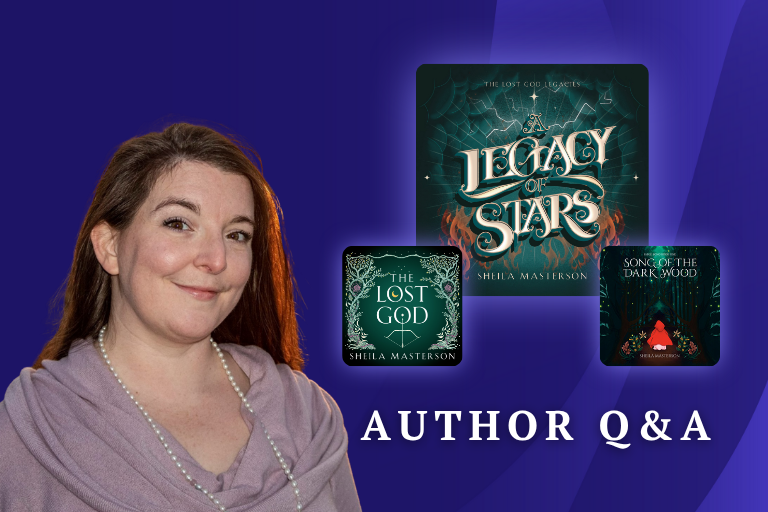
Like many of us, romantasy author (and tarot reader) Sheila Masterson found her way back to writing during the unexpected pause of lockdown.
What started off as a search for “dissociation and joy” soon grew to be so much more! A storyteller at heart, Masterson knew she had at least one story she needed to share. However, when started writing what would become The Lost God, she realized her debut novel was actually the beginning of a 4-book saga — “The Lost God” series.
This thrilling adventure stars refreshingly flawed characters and magic that feels like it could be happening right now, just out of sight. In it, memory witch Cecilia and her guardian Rainer navigate meddling gods, simmering wars, and magical exchanges that challenge everything Cecilia believes—all while exploring the true power of memory to bring people together or tear them apart.
Now, Masterson extends this universe with a standalone next generation spinoff that can be read alone or as a follow up to “The Lost God” series.
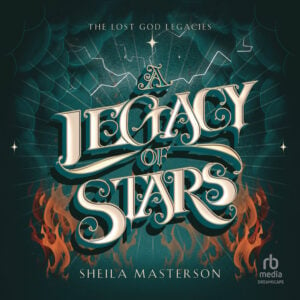
Stella McKay has only ever wanted one thing: an epic romance like her parents have.
She thinks she’s finally found it with Prince Arden, but he is unexpectedly betrothed to someone else. To secure a heart bond and a future where they could be together, Stella and Arden seek out the goddess of love. Instead of granting their wish, the mischievous deity links Stella to the last person she’d ever want to bond with: Teddy Savero.
The only way to break the bond? Win the Gauntlet Games and secure a favor from the gods. Learn more >
To celebrate this new release, we sat down with Sheila Masterson to discuss these descendants of “The Lost God” and how this world came to be.
Keep reading to learn more about her and this new romantasy!
Q: A LEGACY OF STARS is designed as both a standalone novel and a spinoff from The Lost God Series. What challenges did you face in balancing accessibility for new readers while satisfying fans of the original series?
The two main challenges were making the characters feel influenced by the previous generation and world while remaining distinct.
I’m an intuitive writer, which means that I don’t plot in great details before I start writing. I typically have the larger plot beats and details about the characters and their motivation in my head when I start and I discover the details as I go. For ALOS, I already had the entire base of the world and magic in my head from the writing “The Lost God” series, so it was tricky to figure out how to thread the needle of giving enough information that new readers wouldn’t feel lost, while not entirely spoiling the details of the original series. It took a few rounds of edits and some beta readers who were brand new to the series to keep me on track. I think I managed to write it in a way that entices new readers to go back and read the original series while still giving them enough information to feel grounded in this new world.
The secondary challenge was making sure these characters had their own distinct personalities and their own motivations. A lot of their goals are framed by the past generations, and I think you can see their influence, but Teddy and Stella remain their own characters.
Q: Stella begins A LEGACY OF STARS as a romantic idealist, only to be magically bonded to the wrong person. What was the hardest part of writing this “wrong person, right bond” dynamic alongside Stella’s flawed but relatable view of romance?
Stella is like a lot of women in their early twenties in that she’s really eager to be wanted. She’s young enough to be independent and want her own things, but not experienced enough to have been humbled into being careful, and she’s grown up with this larger than life romance in her face.
The challenge with a rivals to lovers storyline and a magical bond, is giving them a really strong and believable motivation to resist what they are feeling. Stella has already decided that she is meant to be with someone else, and she also happens to heartily dislike Teddy.
The two of them are total personality opposites and he is also extremely different from the man Stella thinks she’s in love with. Ultimately, when you’re writing rivals, they already agree about some of their values, because they’re competing over something that they both want. The competition and their bond mean they have both external and internal forced proximity, so the hardest part was making sure that they had really set opinions of each other from the start that would allow them to deny the attraction as long as possible.
Q: Your FMCs often navigate courts, tournaments, and political schemes while pursuing love. What do you hope readers take away from these stories about agency, strength, and finding one’s place in complex power structures?
What I really love about fantasy is that it gives distance from the modern world, while still really effectively hold up a mirror to modern challenges. I’m always trying to show readers different types of resistance and strength. Most of my characters are flawed and messy, but no one needs them to show up perfectly. What they need, and what the other characters need, and even what readers need, is to see they don’t have to have everything figured out to get started. Ultimately, I’m trying to write characters who are learning to show up in the mess, pick themselves up when they get it wrong, and to feel worthy of love even when they’re not fully “healed.”
Q: As both a writer and reader of fantasy romance, how do you balance giving readers the escapism they seek while exploring deeper themes of love, sacrifice, and power?
I’ve often heard this idea from readers that an author will write loved ones into their characters, but I tend to write my experiences into characters. It doesn’t matter that Stella is witch in this fantasy world in the middle of a magical tournament, she’s still frustrated that her boyfriend isn’t showing up for her in the way that she’s been hoping he will. Teddy is a talented fighter but he’s suffering from debilitating anxiety about what failure means not only for him personally, but also for the rest of his family. They’re both facing these tournament challenges, while trying to hold on to the people they love and navigating some pretty chaotic political shakeups—which I think is something we can all relate to.
I took this workshop with romance author Sarah Maclean and she said that romance is the journey from power to parity—we have this inequitable dynamic between characters that needs to be leveled for them to fall in love. One of the things I love about romantasy is that I get to show power in a very literal way. Readers get a clear understanding of the larger power dynamics between characters thanks to magic and world-building, but it’s the romance that shows their more personal relationship with power.
Since ALOS is rivals to lovers, Stella and Teddy are really forced to confront their misperceptions of each other’s social currency in the world. Stella sees how, despite the fact that Teddy can exact real change in his kingdom, he has very little control over his personal life. Teddy sees that while Stella has a lot of freedom, she bears the weight of tremendous societal expectations because of her family legacy. Suddenly, the world is tilted. Their adversary is not as they expected and that is uncomfortable. It’s from that discomfort and the tension of trying to avoid it that they both have huge opportunity to grow.
Q: Your work reimagines classic folklore while exploring the tension between romantic idealism and harsh realities. What draws you to retelling these familiar tales, and how do they help you examine the deeper themes found in your stories like A LEGACY OF STARS?
The great thing about familiar stories and tropes is that they help readers feel grounded. They bring with them a certain set of expectations, that you get to try to subvert as the author. So we have Stella who has grown up with a beautiful love story, and has also heard all these love stories every night before bed, and she and readers come in expecting a specific resolution. As a writer, the fun part is getting to tilt the world on its side for the characters and readers at the same time.
I knew going into this one that a lot of readers would have a certain expectation around the Gauntlet Games Tournament itself, but I think I did a good job subverting expectations with the creatures in the first challenge. It’s one of the things I get the most messages about and I’m very proud of that.
Q: As you are keenly aware, fairy tales and folklore from all cultures came from oral storytelling traditions that go back tens of thousands of years. How do you think your audiobooks keep this tradition alive while bringing ancient stories into the present day?
As an author, I’ve seen how much performance brings a story to life in a new way and makes it even more memorable. When readers tell me about the scenes that stay with them, it’s always those moments where the narrators really brought it. (Huge props to Emily Woo Zeller and James Fouhey who narrated A LEGACY OF STARS).
As a member of the disabled community, I think that audiobooks have allowed disabled folks to be brought back into the storytelling world in a more immersive way, which is always a win.
Beyond that, I think culturally we tend to think of storytelling as something that’s only for children, but I’ve seen how much audiobooks have brought my friends and family back to reading. Audiobooks have become this new way to carry stories with us on the go and there’s a whole new group of readers returning to the joy of storytelling.
At the end of the day, art is relational, and audiobooks bring even more people into the conversation.